მეცნიერება და განსაკუთრებით კი მისი პროდუქტით - ტექნოლოგიით
სარგებლობა ყველას გვიყვარს, ერთეული მცირე ეთნიკური ჯგუფების გამოკლებით
როგორიცაა მაგალითად ამიშების ტომები (Amish), ძნელად თუ მოიძებნება
ადამინი რომელიც ტექნოლოგიის თანამედროვე მიღწევებზე უარს
იტყოდა. მსგავს პრობლემას საქართველოშიც ვხვდებით, როცა თანამედროვეობის კომფორტით სარგებლობას არ თმობენ და ამავდროულად ადამიანის წარმოშობის შესახებ არქაულ წარმოდგენებზეც არ ამობობენ უარს.
მაგრამ სხვისი ნააზრევის და ნამუშევარის ცქერით, წაკითხვით და
მოწონებით დამეთანხმეთ შორს ვერ წავალთ, თუ თავადაც არ მივიღებთ შექმნის პროცესში მონაწილეობა, მომხმარებლის სტატუსს ვერ
გავცდებით.
ჯგუფის სათაურიდან გამომდინარე, გასაგებია რა ინტერესებსაც ემსახურება და
ის რომ მიზნად არ ისახავს სხვა სფეროების ჩართვას, მაგრამ ნასას და სხვა საინტერესო პოსტებთან ერთად, ვფიქრობ მნიშვნელოვანია
იმ ელემენტარული სამეცნიერო მეთოდების პოპულარიზაცია რომელმაც დღევანდელ
დღემდე მოგვიყვანა. კამათი და სადავო საკითხების განხილვა პროგრესის
აუცილებელი ნაწილია.
ამჟამად ჯგუფში მყოფი 252 წევრიდან მხოლოდ 10% პროცენტი თუ აქტიურობს, ისიც ერთი ან ორი თემის ირგვლივ.
უკანასკნელ დღეებში, ქართული პოლიტიკური რეალობა პირწიგნაკზეც პირდაპირ
აისახა და საერთოდ გამიქრა სურვილი შემოვსულიყავი, სათაურების
დონზეც აღარ მინდა ამ ამბების გაგება. ამ პოსტის
დაწერა რადიოთავისუფლების რამოდენიმე სტატიამ გადამაწყვეტინა. კიდევ
ერთხელ გამახსენდა რამდენად დაბალია სამოქალო საზოგადოების ცნობიერება ზოგადად მოსახლეობაში,
ჩემში არსებული თვითცენზურა შეასუსტა და რაც ადრეც ბევრჯერ მიფიქრია,
მაგრამ ხმამაღლა არ მითქვამს ახლა დავაპირე გამეკეთებინა.
თავიდან მხოლოდ რამოდენიმე ადამინისთვის
ვაპირებდი მიწერას, მაგრამ გადავიფიქრე და იყოს ყველას სანახავად,
თქვენც გეფიქრებათ ალბათ ამაზე და ვნახოთ სადამდე მივალთ.
ახლახანს გააქტიურებული რელიგიური ფუნდამენტალიზმის პრობლემა
პირველი არ ყოფილა და ალბათ არც უკანასკნელი იქნება. რელიგიური ფუნამენტალიზმი მხოლოდ
საქართველოს არ აწუხებს, უამრავ ქვეყანაში დგას იგივე პრობლემა მაგრამ
რაღაც ტაქტიკა აქვთ შემუშავებული და მეტ-ნაკლები წარმატებით ამ თემებზე
მსჯელობა მიმდინარეობს. აშშ-ში დასრულებული არჩევნებიც ამის აშკარა მაგალითია. მას-მედია და განსაკუთრებით კი ტელევიზია ამ მხრივ საქართველოში სტერილურია, კამათი ან ჯანსაღი მსჯელობის მოსმენა დიდი ფუფუნებაა, როგორც წესი სადავეები ავტორიტეტებს უპყრიათ ხელთ და არავინ
ეკამათება.
თქვენ როგორ ფიქრობთ, რა არის აქედან გამოსავალი ან არის თუ არა საჭირო რამე გამოსავლის ძიება საჭირო?
Wednesday, November 7, 2012

Wednesday, September 19, 2012
ცოცხი ცოცხის წილ
"ასჯერ გაგონილს, ერთხელ ნანახი ჯობიაო" - პრაქტიკაში ეს ანდაზა გუშინ ვნახე.
როგროც ჩანს, თვალსაჩინოებამ ჩვეული აქტუალობა არ დაკარგა და საკმარისი გავლენა მოახდინა საქართველოს მოსახლეობაზე იმისთვის რომ უამრავი ადამიანი ქუჩაში გამოსულიყო მომხდარის გასაპროტესტებლად. არ ვიცი ვისთვის იყო ეს შემზარავი ვიდეოები მოულოდნელი ან ახალი, აქამდე დროგამოშვებით თუ გავიგებდით წამებისა თუ სიკვდილის ერთეულ ისტორიებს მაგრამ ამ შემთხვევამ როგორც ჩანს ბევრს აუხილა თვალი და ადამიანური ბუნების ყველაზე არასასურველი ხასიათები გააცნო, ვიღაცას კი გაახსენა. გაახსენა რადგან სულ რაღაც ათიოდე წლის წინ, ბევრისთვის იყო ცნობილი რომ ციხესა და ზოგჯერ ჯარშიც, ვინც "ღირსი" იყო აფუჭებდნენ, ადრე ქურდები - ახლა კი მოძალადის მხარე შეიცვალა და წვალების პრივილეგია გაველურებულ დარაჯებს აქვთ (შესაძლებელია მაღალჩინოსანთა თანხმობითა თუ დავალებით).
ყოველდღიური და პრაქტიკული ძალადობა, რომელიც ბევრს ცხოვრების წესად ჰქონდა, კვლავ აქტუალურია, ოღონდ სხვის ხელში.
ჩემთვის სამწუხარო კი ის არის რომ დასასრულიც არსად ჩანს.
ესტაფეტა არ ჩერდება და დაახოებით 30 წლის წინ დაწყებული ეთნო-ნაციონალისტური, რელიგიური ქვეტექსტებით გაჟღენთილი ისტერია, სადაც "ჩვენ" (უმთავრესად ეთნიკური ქართველები) კეთილს განვასახიერებდით და "ისინი" (სსრკ) ბოროტს გრძელდება ოღონდ ლოკალურად, პარტიებს შორის.
ძალადობის სურვილს ახლა უკვე მომხდარის მაყურებლებიც გამოხატავენ, თანაც ქუჩაში გასვლა ან ტელვიზიასთან მისვლა საჭირო აღარ არის, ფეისბუქის პოსტებითა თუ კომენტარებით შეგიძლია დააფიქსირო შენი სამოქალაქო პოზიცია და დაპოსტო რომ "ცოხცი ამათ დედებს უნდა გათხარო, რომ ასეთი კიდევ არ გაუჩნდეთ" არიან ისეთებიც ვინც მოძალადეების დასჯით არ შემოიფარგლა და მის მოსაზრებას თუ არ ეთანხმებიან აი რას სთავაზობს: "ვინც ფიქრობთ რომ ძალადობით არ უნდა უპასუხო, თქვენ უნდა გაგიკეთოთ ცოცხები და დუბინკები ტრაკში და მერე უპასუხეთ ცივილურად და წერილობითი საჩივრებით". მაგალითისთვის, ვიდეოს ვერ გადავიღებ მაგრამ კონკრეტულ შემთხვევას მოვივყვან: მე, რომელიც არ ვფიქრობ რომ დარაჯს იგივე უნდა გაუკეთო რასაც სხვას უკეთებდა, თეორიულად მაინც არიან მომხრეები რომ ტრაკში ცოცხი ან დუბინკა გამიკეთოს. ამიტომ არ უნდა გაგვიკვირდეს და არ უნდა ვიკითხოთ, "სად გაიზარდნენ", "რა დედამ გაზარდა", ისინი ჩვენს ირგვლივ არიან, ჩვენთან ერთად ცხოვრობენ და ნურავინ დაიკვეხნის რომ იცის როგორ მოიქცევა კრიტიკულ ვითარებაში, თანაც როგორც ჩანს, ჩვენ ძალადობის წინააღმდეგი კი არ ვართ, ცოცხების ტრაკში გაკეთებას კი არ ვაპროტესტებთ, პირიქით, მისაღებია, უბრალოდ მხარე არ მოგვწონს და ვინც არ დაგვეთანხმება და ჩვენთან ერთად არ იქნება, ის ჩვენი მტერია...
ძალადობას კი უფრო ღრმა საწყისები აქვს და ადამიანის ცნობიერებასთან ერთად ურთულეს პრობლემას წარმოადგენს განვითრებულ სახელმციფოებშიც, სადაც უფრო ცივილური მეთოდებით უპირისპირდებიან და პროფესიონალების კონსულტირებით იწყება პრობლემასთან ბრძოლა. 1960 წლების ბოლოს შტატებში არა ერთი ფსიქოლოგიური ექსპერიმენტი ჩატარდა ადამიანებში ძალადობის შესასწავლად და შედეგებმა ყველანაირ მოლოდინს გადააჭარბა. აზრი რომ ადამიანები ვართ უზენაესი მორალური ქმნილებები უბრალოდ მცდარია, კვლევების ყველა შედეგი ამ აზრის უზუსტობაზე მიუთითებს. საქართველოში კი ზედაპირული დამოკიდებულების, ემოციების ამარა და პოლიტიკური ვაჭრობის საგნად არის გადაქცეული. ერთ დახურულ და მანკიერ წრეში ტრიალებს, პრეზიდენტი-მინისტრი-ოპოზიცია და გვგონია რომ რომელიმეს აქვს უნარი ან თუნდაც სურვილი ამ არსებული პრობლემის გადასაჭრელად...
"ცოცხების გაგრძელება", უფრო სწორად კი დასაწყისი.
ანუ რატომ ვუყურებთ ამ ვიდეოებს ახლა. ვინ მოგვაწოდა სხვადასხვა დროს, სხვადასხვა დაწესებულებებში გადაღებული ვიდეობი ერთდროულად? რა კავშირია აქვს ამ მოვლენებს 10 დღეში დაგეგმილ არჩევნებთან?
 მოახლოებულ არჩევნებზე სალვადორ დალის სურათი, გეოპოლიტიკური ბავშვი უყურებს ახალი ადამიანის დაბადებას გამახსენდა. სურათში სამი მთავარი პერსოანჟია, ზდასრული ადამიანი ბავშვთან ერთად, რომელიც როგროც ცნობილია სამხრერთ კავკასიაზეა მიუთითებს, (ვიკიპედიის ბმული იხილეთ აქ) და მეორე ზდასრული ადამინი რომელიც დაბადებისას, ამერიკის ტერიტორიიდან კვერსხის გამოტეყვას ცდილობს.
აწ უკვე განვლილი მოკლე უახლესი ისტორიიდან გვახსოვს რომ საქართველოს ლიდერები ყოველთვის კარგად იწყებდნენ და ეს მღელვარებაც შეიძლება ეფექტური ტრამპლინი აღმოჩნდეს დამწყები პოლიტიკოსისთვის.
ამ პროცესების და მოსალოდნელი შედეგების დეტალურ განხილვას მიზანმიმართულად თავს ვარიდებ, ექსპერტები ბლომად გვყავს და ამ თემით სპეკულაციას მათ დავუთმობ.
მე კი იმაზე ვდარდობ რომ პოლიტიკური კულტურა, რომელიც თუ დასაწყისშივე არ გვქონდა, ათწლეულების განმავლობაში მაინც უნდა გამოგვემუშავებინა ან სხვებისგან მაინც გვესწავლა, მიუღწეველია.
მანამდე კი ამომრჩევლების ემოციებით თამაში და კარგად გადამალული ჯოკერები იქნება ჩვენი პოლიტიკის განმსაზრვრელი ფაქტორი.
მე კი იმას ვისურვებდი რომ მსგავსი ტრაგედები ჩვენთვის მწარე გაკვეთილი მაინც იყო და არა არაჩევნების წინ კარგად დაგეგმილი პოლიტიკური სპექტაკლი, რომელიც ერთ ან მეორე პარტიას გაამარჯვებინებს. რადგან ყველგან და ყოველთვის ამომრჩეველს ხანმოკლე მეხსიერება აქვს და ჩვენსავე შეცდომებზე მაინც თუ არ ვისწავლეთ, იგივეს განმეორებისთვის ვართ განწირული
Thursday, October 20, 2011
History of NeuroScience
Some of the improtant dates in the history of neuroscience that might be interesting.
Link to the original Source at washington.edu
4000 B.C. to 0 A.Dca. 4000 B.C. - Euphoriant effect of poppy plant reported in Sumerian recordsca. 4000 B.C. - Clay tablets from Mesopotamia discuss how to use alcohol to dilute medicine ca. 2700 B.C. - Shen Nung originates acupuncture ca. 1700 B.C. - Edwin Smith surgical papyrus written. First written record about the nervous system ca. 1400-1200 B.C. - Ayuvedic system of Hindu medicine develops ca. 500 B.C. - Alcmaion of Crotona dissects sensory nerves ca. 500 B.C. - Alcmaion of Crotona describes the optic nerve ca. 500 B.C. - Empedocles suggests that "visual rays" cause sight 460-379 B.C. - Hippocrates discusses epilepsy as a disturbance of the brain 460-379 B.C. - Hippocrates states that the brain is involved with sensation and is the seat of intelligence 387 B.C. - Plato teaches at Athens. Believes brain is seat of mental process 335 B.C. - Aristotle writes about sleep; believes heart is seat of mental process 335-280 B.C. - Herophilus (the "Father of Anatomy"); believes ventricles are seat of human intelligence 280 B.C. - Erasistratus of Chios notes divisions of the brain | 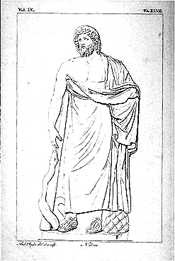 HippocratesImage courtesy of the Blocker History of Medicine Collections, Moody Medical Library, Univ. Texas Med. Branch, Galveston |
0 A.D. to 1500177 - Galen lecture On the Brainca. 100 - Marinus describes the tenth cranial nerve ca. 100 - Rufus of Ephesus describes and names the optic chiasm ca. 390 - Nemesius develops the doctrine of the ventricular localization of all mental functions ca. 900 - Rhazes describes seven cranial nerves and 31 spinal nerves in Kitab al-Hawi Fi Al Tibb ca. 1000 - Alhazen compares the eye to a camera-like device ca. 1000 - Al-Zahrawi (also known as Abulcasis or Albucasis) describes several surgical treatments for neurological disorders 1025 - Avicenna writes about vision and the eye in The Canon of Medicine 1088 - Abu Ruh writes The Light of the Eyes describing several eye operations 1260 - Louis IX founds the Hopital des Quinze-Vingts, the first institution for the blind 1316 - Mondino de'Luzzi writes the first European anatomy textbook (Anothomia) 1402 - St. Mary of Bethlehem Hospital is used exclusively for the mentally ill 1410 - Institution for the mentally ill established in Valencia, Spain | 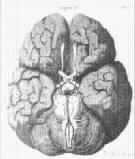 Image courtesy of the National Library of Medicine, Image courtesy of the National Library of Medicine,History of Medicine Collection |
1500 - 16001504 - Leonardo da Vinci produces wax cast of human ventricles1536 - Nicolo Massa describes the cerebrospinal fluid 1538 - Andreas Vesalius publishes Tabulae Anatomicae 1542 - Jean Fernel publishes De naturali parte Medicinae that contains the term "physiology" for the first time 1543 - Andreas Vesalius publishes On the Workings of the Human Body 1543 - Andreas Vesalius discusses the pineal gland and draws the corpus striatum 1549 - Jason Pratensis publishes De Cerebri Morbis, an early book devoted to neurological disease 1550 - Vesalius describes hydrocephalus 1550 - Bartolomeo Eustachio describes the brain origin of the optic nerves 1561 - Gabriele Falloppio publishes Observationes Anatomicae and describes some of the cranial nerves. Separate trochlear and abducens nerves identified 1562 - Bartolomeo Eustachio publishes The Examination of the Organ of Hearing 1564 - Giulio Cesare Aranzi coins the term hippocampus 1573 - Constanzo Varolio names the pons 1573 - Constanzo Varolio is first to cut brain starting at its base 1573 - Girolamo Mercuriali writes De nervis opticis to describe optic nerve anatomy 1583 - Felix Platter states that the lens only focuses light and that the retina is where images are formed 1583 - Georg Bartisch publishes Ophthalmodouleia: das ist Augendienst with drawings of the eye. 1586 - A. Piccolomini distinguishes between cortex and white matter 1587 - Guilio Cesare Aranzi describes ventricles and hippocampus. He also demonstrates that the retina has a reversed image 1590 - Zacharias Janssen invents the compound microscope 1596 - Sir Walter Raleigh mentions arrow poison in his book Discovery of the Large, Rich and Beautiful Empire of Guiana | 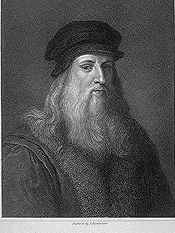 Leonardo Da Vinci 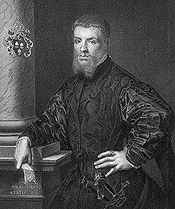 Andreas Vesalius Image courtesy of the Blocker History of Medicine Collections, Moody Medical Library, Univ. Texas Med. Branch, Galveston |
1600 - 17001601 - Hieronymus Fabricius ab Aquapendente publishes Tractatus de Oculo Visusque Organo describing the correct location of the lens relative to the iris1604 - Johannes Kepler describes inverted retinal image 1609 - J. Casserio publishes first description of mammillary bodies 1611 - Lazarus Riverius textbook describing impairments on consciousness published 1621 - Robert Burton publishes The Anatomy of Melancholy about depression 1623 - Benito Daca de Valdes publishes the first book on vision testing and eyeglass-fitting 1641 - Franciscus de la Boe Sylvius describes fissure on the lateral surface of the brain (Sylvian fissure) 1644 - Giovanni Battista Odierna describes the microscopic appearance of the fly eye in L'Occhio della Mosca 1649 - Rene Descartes describes pineal as control center of body and mind 1650 - Franciscus de la Boe Sylvius describes a narrow passage between the third and fourth ventricles (the aqueduct of Sylvius) 1658 - Johann Jakof Wepfer theorizes that a broken brain blood vessel may cause apoplexy (stroke) 1661 - Thomas Willis describes a case of meningitis 1662 - Rene Descartes De homine is published (He died in 1650) 1664 - Thomas Willis publishes Cerebri anatome (in Latin) 1664 - Thomas Willis describes the eleventh cranial nerve (accessory nerve) 1664 - Gerardus Blasius discovers and names the "arachnoid" 1665 - Robert Hooke details his first microscope 1667 - Robert Hooke publishes Micrographia 1668 - l'Abbe Edme Mariotte discovers the blind spot 1670 - William Molins names the trochlear nerve 1673 - Joseph DuVerney uses experimental ablation technique in pigeons 1681 - English edition of Thomas Willis' Cerebri anatome is published 1681 - Thomas Willis coins the term Neurology 1684 - Raymond Vieussens publishes Neurographia Universalis 1684 - Raymond Vieussens uses boiling oil to harden the brain 1686 - Thomas Sydenham describes a form of chorea in children and young adults 1695 - Humphrey Ridley describes the restiform body 1695 - Humphrey Ridley publishes The Anatomy of the Brain 1696 - John Locke writes Essay Concerning Human Understanding 1697 - Joseph G. Duverney introduces the term "brachial plexus" | 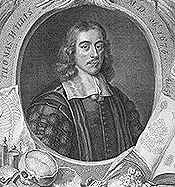 Thomas WillisImage courtesy of the Blocker History of Medicine Collections, Moody Medical Library, Univ. Texas Med. Branch, Galveston |
1700 - 18001704 - Antonio Valsalva publishes On the Human Ear1705 - Antonio Pacchioni describes arachnoid granulations 1709 - Domenico Mistichelli describes the pyramidal decussation 1709 - George Berkeley publishes New Theory of Vision 1717 - Antony van Leeuwenhoek describes nerve fiber in cross section 1721 - The word "anesthesia" first appears in English (in Dictionary Britannicum) 1736 - Jean Astruc coins the term reflex 1740 - Emanuel Swedenborg publishes Oeconomia regni animalis 1749 - David Hartley publishes Observations of Man, the first English work using the word "psychology" 1750 - Jacques Daviel performs the first cataract extraction on a living human eye 1752 - The Society of Friends establishes a hospital-based environment for the mentally ill in Philadelphia 1755 - J.B. Le Roy uses electroconvulsive therapy for mental illness 1760 - Arne-Charles Lorry demonstrates that damage to the cerebellum affects motor coordination 1764 - Domenico F.A. Cotugno describes spinal subarachnoid cerebrospinal fluid; shows that ventricular and spinal fluids are connected 1764 - The interventricular foramen (Foramen of Monroe) is named after Alexander Monroe; it was described earlier by Vieussens 1766 - Albrecht von Haller provides scientific description of the cerebrospinal fluid 1772 - John Walsh conducts experiments on torpedo (electric) fish 1773 - John Fothergill describes trigeminal neuralgia (tic douloureux, Fothergill's syndrome) 1773 - Sir Joseph Priestley discovers nitrous oxide 1774 - Franz Anton Mesmer introduces "animal magnetism" (later called hypnosis) 1776 - M.V.G. Malacarne publishes first book solely devoted to the cerebellum 1777 - Philip Meckel proposes that the inner ear is filled with fluid, not air 1778 - Samuel Thomas von Soemmerring presents the modern classification of the twelve cranial nerves 1779 - Antonius Scarpa describes Scarpa's ganglion of the vestibular system 1781 - Felice Fontana describes the microscopic features of axoplasm from an axon 1782 - Francesco Gennari publishes work on "lineola albidior" (later known as the stripe of Gennari) 1782 - Francesco Buzzi identifies the fovea 1783 - Alexander Monro describes the foramen of Monro 1784 - Benjamin Rush writes that alcohol can be an addictive drug 1784 - Benjamin Franklin mentions bifocal eyeglasses in a letter to George Whatley 1786 - Felix Vicq d'Azyr discovers the locus coeruleus 1786 - Samuel Thomas Sommering describes the optic chiasm 1786 - Georg Joseph Beer founds the first eye hospital in Vienna 1790 - Johannes Ehrenritter describes the glossopharygeal nerve ganglion 1791 - Luigi Galvani publishes work on electrical stimulation of frog nerves 1791 - Samuel Thomas von Soemmering names the macula lutea of the retina 1796 - Johann Christian Reil describes the insula (island of Reil) 1798 - John Dalton, who was red-green colorblind, provides a scientific description of color blindness | 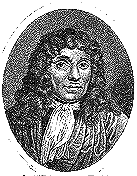 Antony van Leeuwenhoek 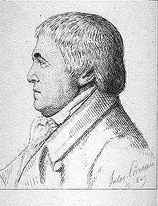 Franz Anton Mesmer Images courtesy of the Blocker History of Medicine Collections, Moody Medical Library, Univ. Texas Med. Branch, Galveston |
1800 - 1850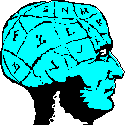 1800 - Alessandro Volta invents the wet cell battery 1800 - Alessandro Volta invents the wet cell battery1800 - Humphrey Davy synthesizes nitrous oxide 1800 - Samuel von Sommering identifies black material in the midbrain and calls it the "substantia nigra" 1801 - Thomas Young describes astigmatism 1801 - Adam Friedrich Wilhelm Serturner crystalizes opium and obtains morphine 1808 - Franz Joseph Gall publishes work on phrenology 1809 - Johann Christian Reil uses alcohol to harden the brain 1809 - Luigi Rolando uses galvanic current to stimulate cortex 1811 - Julien Jean Legallois discovers respiratory center in medulla 1811 - Charles Bell discusses functional differences between dorsal and ventral roots of the spinal cord 1812 - Benjamin Rush publishes Medical Inquiries and Observations upon the Diseases of the Mind 1813 - Felix Vicq d'Azyr discovers the claustrum 1817 - James Parkinson publishes An Essay on the Shaking Palsy 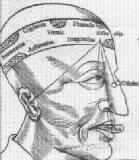 1818 - Library of the Surgeon General's Office established (later to become the Army Medical Library and then the National Library of Medicine) 1818 - Library of the Surgeon General's Office established (later to become the Army Medical Library and then the National Library of Medicine)1820 - Galvanometer invented 1821 - Charles Bell describes facial paralysis ipsilateral to facial nerve lesion (Bell's palsy) 1821 - Francois Magendie discusses functional differences between dorsal and ventral roots of the spinal cord 1822 - Friedrich Burdach names the cingular gyrus 1822 - Friedrich Burdach distinguishes lateral and medial geniculate 1823 - Marie-Jean-Pierre Flourens states that cerebellum regulates motor activity 1824 - John C. Caldwell publishes Elements of Phrenology 1824 - Marie-Jean-Pierre Flourens details ablation to study behavior 1824 - F. Magendie provides first evidence of cerebellum role in equilibration 1825 - John P. Harrison first argues against phrenology 1825 - Jean-Baptiste Bouillaud presents cases of loss of speech after frontal lesions 1825 - Robert B. Todd discusses the role of the cerebral cortex in mentation, corpus striatum in movement and midbrain in emotion 1825 - Luigi Rolando describes the sulcus that separates the precentral and postcentral gyri 1826 - Johannes Muller publishes theory of "specific nerve energies" 1827 - E. Merck & Company market morphine 1832 - Justus von Liebig discovers chloral hydrate 1832 - Jean-Pierre Robiquet isolates codeine 1832 - Massachusetts establishes a "State Lunatic Hospital" for the mentally ill 1832 - Sir Charles Wheatstone invents the stereoscope 1833 - Philipp L. Geiger isolates atropine 1834 - Ernst Heinrich Weber publishes theory of "Just Noticeable Difference" or "Weber's Law" 1836 - Marc Dax reads paper on left hemisphere damage effects on speech 1836 - Gabriel Gustav Valentin identifies neuron nucleus and nucleolus 1836 - Robert Remak describes myelinated and unmyelinated axons 1836 - Charles Dickens (the novelist) describes obstructive sleep apnea 1837 - Jan Purkyne (Purkinje) describes cerebellar cells; identifies neuron nucleus and processes 1837 - The American Physiological Society is founded 1838 - Robert Remak suggests that nerve fiber and nerve cell are joined 1838 - Theordor Schwann describes the myelin-forming cell in the peripheral nervous system ("Schwann cell") 1838 - Jean-Etienne-Dominique Esquirol publishes Des Maladies Mentales, possibly the first modern work about mental disorders 1838 - Napoleonic Code leads to the requirement of facilities for the mentally ill 1838 - Eduard Zeis publishes study about dreams in people who are blind 1839 - Theordor Schwann proposes the cell theory 1839 - C. Chevalier coins the term microtome 1839 - Francois Leuret names the Rolandic sulcus for Luigi Rolando 1840 - Moritz Heinrich Romberg describes a test for conscious proprioception (Romberg test) 1840 - Adolph Hannover uses chromic acid to harden nervous tissue 1840 - Jules Gabriel Francois Baillarger discusses the connections between white and gray matter of cerebral cortex 1840 - Adolphe Hannover discovers the ganglion cells of the retina 1841 - Dorothea Lynde Dix investigates brutality within mental hospitals in the United States 1842 - Benedikt Stilling is first to study spinal cord in serial sections 1842 - Crawford W. Long uses ether on man 1842 - Francois Magendie describes the median opening in the roof of the fourth ventricle (foramen of Magendie) 1843 - James Braid coins the term "hypnosis" 1844 - Robert Remak provides first illustration of 6-layered cortex 1844 - Horace Wells uses nitrous oxide during a tooth extraction 1846 - William Morton demonstrates ether anesthesia at Massachusetts General Hospital 1847 - Chloroform anesthesia used by James Young Simpson 1847 - American Medical Association is founded 1847 - The American Association for the Advancement of Science is founded 1848 - Phineas Gage has his brain pierced by an iron rod 1848 - Richard Owen coins the word "notochord" 1849 - Hermann von Helmholtz measures the speed of frog nerve impulses |
1850 - 19001850 - Augustus Waller describes appearance of degenerating nerve fibers1850 - Marshall Hall coins the term spinal shock 1850 - Emil Du Bois-Reymond invents nerve galvanometer 1851 - Jacob Augustus Lockhart Clarke describes the nucleus dorsalis, an area in the intermediate zone of the spinal cord gray matter 1851 - Heinrich Muller is first to describe the colored pigments in the retina 1851 - Marchese Alfonso Corti describes the cochlear receptor organ in the inner ear (organ of Corti) 1851 - Hermann von Helmholtz invents ophthalmoscope 1851 - Andrea Verga describes the cavum vergae 1852 - A. Kolliker describes how motor nerves originate from the neurons in the anterior horn of the spinal cord 1852 - George Meissner and Rudolf Wagner describe encapsulated nerve endings later known as "Meissner's corpuscles" 1853 - William Benjamin Carpenter proposes "sensory ganglion" (thalamus) as seat of consciousness 1854 - Louis P. Gratiolet describes convolutions of the cerebral cortex 1855 - Bartolomeo Panizza shows the occipital lobe is essential for vision 1855 - Richard Heschl describes the transverse gyri in the temporal lobe (Heschl's gyri) 1856 - Albrecht von Graefe describes homonymous hemianopia 1858 - Joseph von Gerlach stains brain tissue with a carmine solution 1859 - Charles Darwin publishes The Origin of Species 1859 - Rudolph Virchow coins the term neuroglia 1860 - Albert Niemann purifies cocaine 1860 - Gustav Theodor Fechner develops "Fechner's law" 1860 - Karl L. Kahlbaum describes and names "catatonia" 1861 - Paul Broca discusses cortical localization 1861 - T.H. Huxley coins the term calcarine sulcus 1862 - William Withey Gull describes clinical signs of syringomyelia 1862 - Hermann Snellen invents the eyechart with letters to test vision 1863 - Foramen of Luschka named after Hubert von Luschka 1863 - Ivan Mikhalovich Sechenov publishes Reflexes of the Brain 1863 - Nikolaus Friedreich describes a progressive hereditary degenerative CNS disorder (Friedreich's ataxia) 1864 - John Hughlings Jackson writes on loss of speech after brain injury 1865 - Otto Friedrich Karl Deiters differentiates dendrites and axons 1865 - Otto Friedrich Karl Deiters describes the lateral vestibular nucleus (Deiter's nucleus) 1866 - John Langdon Haydon Down publishes work on congenital "idiots" 1866 - Julius Bernstein hypothesized that a nerve impulse is a "wave of negativity" 1866 - Leopold August Besser coins the term "Purkinje cells" 1867 - Theodore Meynert performs histologic analysis of cerebral cortex 1868 - Julius Bernstein measures the time course of the action potential 1868 - Friedrich Goll describes the fasciculus gracilis 1869 - Francis Galton claims that intelligence is inherited (publication of Hereditary Genius) 1869 - Johann Friedrich Horner describes eye disorder (small pupil, droopy eyelid) later to be called "Horner's syndrome" 1870 - Eduard Hitzig and Gustav Fritsch discover cortical motor area of dog using electrical stimulation 1870 - Ernst von Bergmann writes first textbook on nervous system surgery 1871 - Weir Mitchell provides detailed account of phantom limb syndrome 1872 - George Huntington describes symptoms of a hereditary chorea 1872 - Sir William Turner describes the interparietal sulcus 1872 - Charles Darwin publishes The Expression of Emotions in Man and Animals 1873 - Camillo Golgi publishes first work on the silver nitrate method 1874 - Jean Martin Charcot describes amyotrophic lateral sclerosis 1874 - Vladimir Alekseyevich Betz publishes work on giant pyramidal cells 1874 - Roberts Bartholow electrically stimulates human cortical tissue 1874 - Carl Wernicke publishes Der Aphasische Symptomencomplex on aphasias 1875 - Sir David Ferrier describes different parts of monkey motor cortex 1875 - Richard Caton is first to record electrical activity from the brain 1875 - Wilhelm Heinrich Erb and Carl Friedrich Otto Westphal describe the knee jerk reflex 1876 - David Ferrier publishes The Functions of the Brain 1876 - Franz Christian Boll discovers rhodopsin 1876 - Francis Galton uses the term "nature and nurture" to explain "heredity and environment" 1877 - Jean-Martin Charcot publishes Lectures on the Diseases of the Nervous System 1878 - W. Bevan Lewis publishes work on giant pyramidal cells of human precentral gyrus 1878 - Claude Bernard describes nerve/muscle blocking action of curare 1878 - The first Ph.D. with "psychology" in its title is given to Granville Stanley Hall at Harvard University 1878 - Paul Broca publishes work on the "great limbic lobe" 1878 - W.R. Gowers publishes Unilateral Gunshot Injury to the Spinal Cord 1878 - Harmon Northrop Morse synthesized acetaminophen (paracetamol) 1878 - Louis-Antoine Ranvier describes regular interruptions in the myelin sheath (nodes of Ranvier) 1879 - Camillo Golgi describes the "musculo-tendineous organs" (later to be know as the "Golgi tendon organs") 1879 - Mathias Duval introduces an improved method of embedding tissue using collodion 1879 - Hermann Munk presents detailed anatomy of the optic chiasm 1879 - William Crookes invents the cathode ray tube 1879 - Wilhelm Wundt sets up lab devoted to study human behavior 1880 - Jean Baptiste Edouard Gelineau introduces the word "narcolepsy" 1880 - Friedrich Sigmund Merkel describes free nerve endings later known as "Merkel's corpuscles" 1881 - Hermann Munk reports on visual abnormalities after occipital lobe ablation in dogs 1883 - Sir Victor Horsley describes effects of nitrous oxide anesthesia 1883 - Emil Kraepelin coins the terms neuroses and psychoses 1884 - Franz Nissl describes the granular endoplasmic reticulum ("Nissl Substance") 1884 - Karl Koller discovers anesthetic properties of cocaine 1884 - Georges Gilles de la Tourette describes several movement disorders 1884 - Theodor Meynert publishes A Clinical Treatise on the Diseases of the Forebrain 1885 - Paul Ehrlich notes that intravenous dye does not stain brain tissue 1885 - Carl Weigert introduces hematoxylin to stain myelin 1885 - Ludwig Edinger describes nucleus that will be known as the Edinger-Westphal nucleus 1885 - Hermann Ebbinghaus publishes On Memory 1886 - Joseph Jastrow earns the first Ph.D. from the first formal PhD program in psychology at Johns Hopkins University 1886 - V. Marchi publishes procedure to stain degenerating myelin 1887 - Sergei Korsakoff describes symptoms characteristic in alcoholics 1887 - The National Institutes of Health established 1887 - Alfred Binet and C. Fere publish Animal Magnetism, a study on hypnosis 1887 - Adolf Eugen Fick makes the first contact lens out of glass for vision correction 1888 - William Gill describes anorexia nervosa 1888 - William W. Keen, Jr. is first American to remove intracranial meningioma 1888 - Hans Chiari introduces the term "syringomyelia" 1888 - Giovanni Martinotti describes cortical cells later known as "Martinotti cells" 1889 - Santiago Ramon y Cajal argues that nerve cells are independent elements 1889 - William His coins the term dendrite 1889 - Sir Victor Horsley publishes somatotopic map of monkey motor cortex 1889 - Carlo Martinotti describes cortical neuron with ascending axon (this neuron now bears his name, Martinotti cell) 1889 - F.C. Muller-Lyer discovers the Muller-Lyer illusion 1890 - Wilhelm Ostwald discovers the membrane theory of nerve conduction 1890 - William James publishes Principles of Psychology 1890 - The term "mental tests" was coined by James Cattell 1891 - H. Quincke introduces the lumbar puncture 1891 - Wilhelm von Waldeyer coins the term neuron 1891 - Luigi Luciani publishes manuscript on the cerebellum 1891 - Heinrich Quinke develops the lumbar puncture (spinal tap) 1892 - Salomen Eberhard Henschen localizes vision to calcarine fissure 1892 - American Psychological Association formed 1892 - Arnold Pick first describes "Pick's disease" 1893 - Paul Emil Flechsig describes myelinization of the brain 1893 - Charles Scott Sherrington coins the term proprioceptive 1894 - Franz Nissl stains neurons with dahlia violet 1894 - Margaret Floy Washburn is the first woman to receive a Ph.D. (Cornell University) in psychology 1895 - William His first uses the term hypothalamus 1895 - Wilhelm Konrad Roentgen invents the X-ray 1895 - Heinrick Quincke performs lumbar puncture to study cerebrospinal fluid 1895 - Formalization of the cranial nerve number system published in Basle Nomina Anatomica 1896 - Max von Frey details "stimulus hairs" to test the somatosensory system 1896 - Rudolph Albert von Kolliker coins the term axon 1896 - Camillo Golgi discovers the Golgi apparatus 1896 - Joseph Babinski describes the Babinski Sign 1896 - Emil Kraeplein describes dementia praecox 1897 - Ivan Petrovich Pavlov publishes work on physiology of digestion 1897 - Karl Ferdinand Braun invents the oscilloscope 1897 - John Jacob Abel isolates adrenalin 1897 - Charles Scott Sherrington coins the term synapse 1897 - Ferdinand Blum uses formaldehyde as brain fixative 1897 - Acetylsalicylic acid (aspirin) is synthesized by Felix Hoffmann 1898 - Charles Scott Sherrington describes decerebrate rigidity in cat 1898 - Edward Lee Thorndike describes the puzzle box 1898 - Bayer Drug Company markets heroin as nonaddicting cough medicine 1898 - John Newport Langley coins the term autonomic nervous system 1898 - Angelo Ruffini describes encapsulated nerve endings later known as Ruffini corpuscles 1899 - Francis Gotch describes a "refractory phase" between nerve impulses 1899 - Bayer AG markets aspirin 1899 - Karl Gustav August Bier uses cocaine for intraspinal anesthesia | 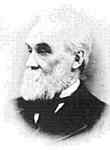 John Hughlings Jackson Image courtesy of the National Library of Medicine, History of Medicine Collection 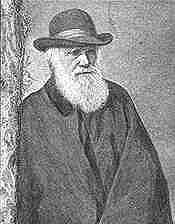 Charles Darwin 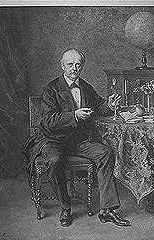 Hermann von Helmholtz 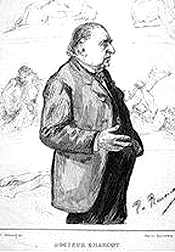 Jean-Martin Charcot 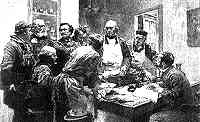 Claude Bernard Images courtesy of the Blocker History of Medicine Collections, Moody Medical Library, Univ. Texas Med. Branch, Galveston 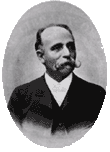 Camillo Golgi Courtesy of the National Library of Medicine. |
1900 - 19501900 - Sigmund Freud publishes The Interpretation of Dreams1900 - Charles Scott Sherrington states that cerebellum is head ganglion of the proprioceptive system 1900 - M. Lewandowsky coins the term "blood-brain barrier" (Bluthirnschranke) [ref: Aschner and Kerper, Mol. Biol. and Tox. of Metals, 2000] 1902 - Julius Bernstein proposes membrane theory for cells 1902 - Physiologist Ida Hyde is the first woman elected to the American Physiological Society 1903 - Ivan Pavlov coins the term conditioned reflex 1903 - Alfred Walter Campbell studies cytoarchitecture of anthropoid cerebral cortex 1904 - Procaine is synthesized 1905 - Alfred Binet and Theodore Simon have their first intelligence test 1905 - John Newport Langley coins the phrase "parasympathetic nervous system" 1906 - Alois Alzheimer describes presenile degeneration 1906 - Golgi and Cajal-Nobel Prize-Structure of the Nervous System 1906 - Sir Charles Scott Sherrington publishes The Integrative Action of the Nervous system that describes the synapse and motor cortex 1907 - Ross Granville Harrison describes tissue culture methods 1907 - John Newport Langley introduces the concept of receptor molecules 1908 - Vladimir Bekhterew describes the superior nucleus of the vestibular nerve (Bekhterew's nucleus) 1908 - Victor Alexander Haden Horsley and Robert Henry Clarke design stereotaxic instrument 1908 - Willem Einthoven makes string galvanometer recordings from the vagus nerve 1908 - Oberga introduces the cisterna puncture, a method to access the cerebrospinal fluid through the cistena magna 1909 - Harvey Cushing is first to electrically stimulate human sensory cortex 1909 - Korbinian Brodmann describes 52 discrete cortical areas 1909 - Karl Jaspers publishes General Mental Illness 1910 - Emil Kraepelin names Alzheimer's disease 1911 - Allvar Gullstrand-Nobel Prize-Optics of the eye 1911 - Eugen Bleuler coins the term schizophrenia 1911 - George Barger and Henry Dale discover norepinephrine (noradrenaline) 1912 - Original formula for the intelligence quotient (IQ) developed by William Stern 1913 - Santiago Ramon y Cajal develops gold chloride-mercury stain to show astrocytes 1913 - Edwin Ellen Goldmann finds blood brain barrier impermeable to large molecules 1913 - Edgar Douglas Adrian publishes work on all-or-none principle in nerve 1913 - Walter Samuel Hunter devises delayed-response test 1914 - Robert Barany-Nobel Prize-Vestibular apparatus 1914 - Henry H. Dale isolates acetylcholine 1915 - J.G. Dusser De Barenne describes activity of brain after strychnine application 1915 - Aspirin becomes available without a prescription 1916 - Richard Henneberg coins the term cataplexy 1916 - George Guillain, Jean Alexander Barre and Andre Strohl describe an acute inflammatory demyelinating polyneuropathy (Guillain-Barre Syndrome) 1916 - Shinobu Ishihara publishes a set of plates to test color vision 1918 - Walter E. Dandy introduces the ventriculography 1919 - Cecile Vogt describes over 200 cortical areas 1919 - Walter E. Dandy introduces the air encephalography 1919 - Gordon Morgan Holmes localizes vision to striate area 1919 - Pio del Rio Hortega divides neuroglia into microglia and oligodendroglia 1920 - Society of Neurological Surgeons is founded 1920 - Henry Head publishes Studies in Neurology 1920 - Stephen Walter Ranson demonstrates connections between the hypothalamus and pituitary 1920 - John B. Watson and Rosalie Rayner publish experiments about classical conditioning of fear (Little Albert experiments) 1921 - Otto Loewi publishes work on Vagusstoff 1921 - Hermann Rorschach develops the inkblot test 1921 - John Augustus Larsen and Leonard Keeler develop the polygraph 1921 - del Rio Hortega describes microglia 1922 - Army Medical Library established (was the Library of the Surgeon General's Office) 1924 - Charles Scott Sherrington discovers the stretch reflex 1925 - C. von Economo and G.N. Koskinas revise Brodmann's cortical nomenclature of the cerebral cortex 1926 - Percival Bailey and Harvey Cushing publish paper describing more the 2,000 neuroepithelial neoplasms 1927 - Chester William Darrow studies galvanic skin reflex in US 1928 - Philip Bard suggests the neural mechanism of rage is in the diencephalon 1928 - Walter Rudolph Hess reports "affective responses" to hypothalamic stimulation 1928 - John Fulton publishes his observations (made in 1926 and 1928) of the sounds of blood flowing over the human visual cortex 1929 - Hans Berger publishes his findings about the first human electroencephalogram 1929 - Karl Lashley defines "equipotentiality" and "mass action" 1927 - J. Wagner-Jauregg - Nobel Prize-Malaria to treat dementia paralyses 1928 - Edgar Douglas Adrian publishes The Basis of Sensation 1929 - Joseph Erlanger and Herbert Spencer Gasser publish work on the correlation of nerve fiber size and function 1929 - Walter B. Cannon coins the term homeostasis 1930 - John Carew Eccles shows central inhibition of flexor reflexes 1931 - Ulf Svante von Euler and J.H. Gaddum discover substance P 1932 - Max Knoll and Ernst Ruska invent the electron microscope 1932 - Jan Friedrich Tonnies develops multichannel ink-writing EEG machine 1932 - Edgar Douglas Adrian and Charles S. Sherrington share Nobel Prize for work on the function of neurons 1932 - Jan Friedrich Toennies and Brian Matthews design the differential amplifier 1932 - Smith, Kline and French introduce the first amphetamine, Benzedrine 1933 - Ralph Waldo Gerard describes first experimental evoked potentials 1934 - S. Howard Bartley performs studies on cortical visual evoked potentials in rabbits 1935 - Dexedrine (an amphetamine) introduced to treat narcolepsy 1935 - Frederic Bremer uses cerveau isole preparation to study sleep 1936 - Egas Moniz publishes work on the first human frontal lobotomy 1936 - Henry Hallett Dale and Otto Loewi share Nobel Prize for work on the chemical transmission between nerves 1936 - Walter Freeman performs first lobotomy in the United States 1937 - James Papez publishes work on limbic circuit 1936 - Massachusetts General Hospital has first EEG laboratory 1937 - Heinrich Kluver and Paul Bucy publish work on bilateral temporal lobectomies 1937 - James W. Papez develops "visceral theory" of emotion 1937 - John Zachary Young suggests that the squid giant axon can be used to understand nerve cells 1938 - Isador Rabi coins term "magnetic resonance" 1938 - B.F. Skinner publishes The Behavior of Organisms that describes operant conditioning 1938 - Albert Hofmann synthesizes LSD 1938 - Ugo Cerletti and Lucino Bini treat human patients with electroshock 1938 - Franz Kallmann publishes The Genetics of Schizophrenia 1939 - Carl Pfaffman describes directionally sensitive cat mechanoreceptors 1939 - Nathaniel Kleitman publishes Sleep and Wakefulness 1942 - Stephen Kuffler develops the single nerve-muscle fiber preparation 1943 - John Raymond Brobeck describes hypothalamic hyperphasia 1944 - Joseph Erlanger and Herbert Spencer Gasser share Nobel Prize for work on the functions of single nerve fiber 1946 - Theodor Rasmussen describes the olivocochlear bundle (bundle of Rasmussen) 1946 - President Truman signs the National Mental Health Act 1947 - The American EEG Society is founded 1948 - The World Health Organization is founded 1949 - Kenneth Cole develops the voltage clamp 1949 - A.C.A.F. Egas Moniz-Nobel Prize-Leucotomy to treat certain psychoses 1949 - Walter Rudolph Hess receives Nobel Prize for work on the "Interbrain" 1949 - Horace Winchell Magoun defines the reticular activating system 1949 - John Cade discovers that lithium is an effective treatment for bipolar depression 1949 - Giuseppi Moruzzi and Horace Winchell Magoun publish Brain Stem Reticular Formation and Activation of the EEG 1949 - National Institute of Mental Health was formally established 1949 - Donald Olding Hebb publishes The Organization of Behavior: A Neuropsychological Theory | 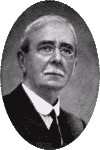 Charles Scott Sherrington Courtesy of the National Library of Medicine. 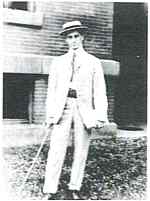 Harvey Cushing Courtesy of the National Library of Medicine 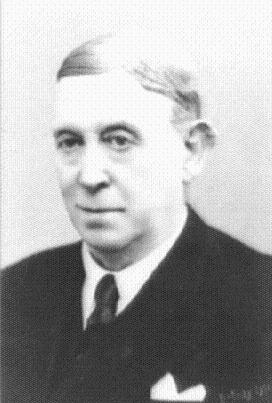 Egas Moniz Courtesy of the National Library of Medicine |
1950 - present1950 - Karl Lashley publishes In Search of the Engram1950 - Eugene Roberts and J. Awapara independently identify GABA in the brain 1950 - The National Institute of Neurological Disorders and Stroke established (it has gone through several name changes) 1951 - MAO-inhibitors introduced to treat psychotics 1951 - B.F. Skinner describes shaping in a paper titled How to Teach Animals 1952 - Alan Lloyd Hodgkin and Andrew Fielding Huxley first describe the voltage clamp 1952 - The Diagnostic and Statistic Manual of Mental Disorders (DSM) was published by the American Psychiatric Association 1953 - Brenda Milner discusses patient HM who suffers from memory loss of hippocampal surgery 1953 - Eugene Aserinski and Nathaniel Kleitman describe rapid eye movements (REM) during sleep 1953 - H. Kluver and E. Barrera introduce Luxol fast blue MBS stain 1953 - Stephen Kuffler publishes work on center-surround, on-off organization of retinal ganglion cell receptive fields 1954 - James Olds describes rewarding effects of hypothalamic stimulation 1954 - John Lilly invents the "isolation tank" 1954 - Chlorpromazine was approved by the U.S. Food and Drug Administration 1956 - L. Leksell uses ultrasound to examine the brain 1956 - National Library of Medicine named (was the Army Medical Library) 1956 - Rita Levi-Montalcini and Stanley Cohen isolate and purify nerve growth factor 1957 - W. Penfield and T. Rasmussen devise motor and sensory homunculus 1957 - The American Medical Association recognizes alcoholism as a disease 1958 - Haloperidol introduced as a neuroleptic drug 1959 - P. Karlson and M. Lusher coin the term "pheromone" 1960 - Oleh Hornykiewicz shows that brain dopamine is lower than normal in Parkinson's disease patients 1961 - Georg Von Bekesy awarded the Nobel Prize for his work on the function of the cochlea 1961 - Levadopa successfully treats parkinsonism 1962 - Eldon Foltz performs the first cingulotomy to treat chronic pain 1963 - John Carew Eccles, Alan Lloyd Hodgkin and Andrew Fielding Huxley share Nobel Prize for work on the mechanisms of the neuron cell membrane 1965 - Ronald Melzack and Patrick D. Wall publish gate control theory of pain 1965 - Drug Abuse Control Act 1967 - Ragnar Arthur Granit, Halden Keffer Hartline and George Wald share Nobel Prize for work on the mechanisms of vision 1968 - Alexander Romanovich Luria publishes The Mind of a Mnemonist; A Little Book About a Vast Memory 1968 - National Eye Institute is established 1969 - D.V. Reynolds describes the analgesic effect of electrical stimulation of the periaqueductal gray 1969 - The Society for Neuroscience is formed 1970 - Julius Axelrod, Bernard Katz and Ulf Svante von Euler share Nobel Prize for work on neurotransmitters 1972 - Godfrey N. Hounsfield develops x-ray computed tomography 1973 - Candace Pert and Solomon Snyder demonstrate opioid receptors in brain 1973 - Sinemet is introduced as a treatment for Parkinson's disease 1973 - Konrad Z. Lorenz, Nikolaas Tinbergen and Karl von Frisch share Nobel Prize for work on ethology 1973 - Timothy Bliss and Terje Lomo describe long-term potentiation 1974 - National Institute on Drug Abuse established 1974 - International Association for the Study of Pain founded 1974 - John Hughes and Hans Kosterlitz discover enkephalin 1974 - M.E.Phelps, E.J.Hoffman and M.M.Ter Pogossian develop first PET scanner 1974 - First NMR image (a mouse) is taken 1975 - John Hughes and Hans Kosterlitz publish work on enkephalins 1976 - Choh Hao Li and David Chung publish work on beta-endorphin 1976 - Erwin Neher and Bert Sakmann develop the patch-clamp technique 1977 - Roger Guillemin and Andrew Victor Schally share Nobel Prize for work on peptides in the brain 1981 - David Hunter Hubel and Torsten N. Wiesel-Nobel Prize-visual system 1981 - Roger Wolcott Sperry awarded Nobel Prize-functions brain hemispheres 1982 - Bengt Ingemar Bergstrom, John Robert Vane and Sune K. Bergstrom awarded Nobel Prize for the discovery of prostaglandins 1986 - Stanley Cohen and Rita Levi-Montalcini awarded Nobel prize for their work on the control of nerve cell growth 1987 - Fluoxetine (Prozac) introduced as treatment for depression 1990 - U.S. President George Bush declares the decade starting in 1990 the "Decade of the Brain" 1991 - Erwin Neher and Bert Sakmann share the Nobel Prize for their work on the function of single ion channels 1992 - National Institute on Drug Abuse becomes part of the National Institutes of Health 1992 - Giacomo Rizzolatti describes mirror neurons in area F5 of the monkey premotor cortex 1993 - The gene responsible for Huntington's disease is identified 1994 - Alfred G. Gilman and Martin Rodbell share the Nobel Prize for their discovery of G-protein coupled receptors and their role in signal transduction 1997 - Stanley B. Prusiner awarded the Nobel Prize for the discovery of prions; a new biological principle of infection 2000 - Arvid Carlsson, Paul Greengard and Eric Kandel share the Nobel Prize for their discoveries concerning signal transduction in the nervous system 2004 - Linda B. Buck and Richard Axel share the Nobel Prize for their discoveries about odorant receptors and the organization of the olfactory system |  Wilder Penfield 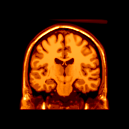 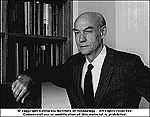 Roger Sperry Courtesy of the Archives California Institute of Technology |
Subscribe to:
Comments (Atom)